
Environmental and Ecological Education
Over the years de Aventura has endeavored so that each of its activities is enriched with knowledge, environmental and ecological education for greater awareness and conservation of nature (Fig.1). The marine side is, of course, the one that ends up having the most impact. When you observe such emblematic animals as dolphins and whales empathy between clients and observed species is almost immediate. It is precisely at this time that the issues of nature conservation arise and it is possible to instill some awareness of environmental issues. Therefore, it is increasingly important to invest in the environmental and ecological education of society.

But the trips are short, the season of activity has been increasing but it is still seasonal, and there is still a long way to go to raise public awareness regarding the conservation of the marine environment.
It was for this reason that, in 2013, the team of biologists from Picos de Aventura invested in environmental and ecological education by creating the Picoslogiathe scientific-pedagogical department whose main motivation is environmental education and public awareness of nature conservation. And what is their target audience? Most of them are kindergarten and elementary school children (1st and 2nd cycle), although the pedagogical sessions have already successfully covered secondary education and even daycare centers.
Not being able to take all children and young people to the sea for a closer contact with marine biodiversity, so why not take to schools a sample of what is the day-to-day of the "whale watchers”? Combining image, sound, interactive games, memories and even a little theater, it was possible to reach the student community and create a positive impact on the knowledge of the species that can be seen in the waters of the Azores (Fig. 2).

The environmental and ecological education sessions are tailored to different age groups. For example, from 2 to 4 years old, it is possible to convey the differences between fish and marine mammals, show the main characteristics of the best-known species and even tell stories about turtles and the problem of ingesting plastics. The feedback from such young children has been fantastic.
In preschool, it is possible to transmit a little more knowledge and even emotions, with the simulation of a very interactive cetacean observation tripFig.3). Adding several fundamental pieces to the trips, videos, sounds and a little theatre, children start by discovering the differences between fish and marine mammals, the ecology of the most emblematic species and, at these inquisitive and imaginative ages, it is already possible to raise awareness of the preservation of the marine environment.

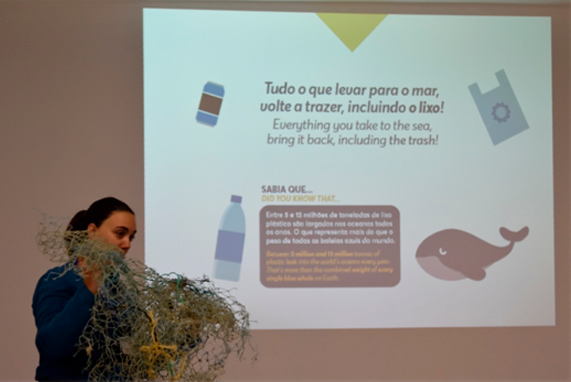
From basic education onwards, the sessions turn into lectures that address not only the topics mentioned above, but also the history that involves the Azoreans, the sea and whales. Making the connection between whaling and what remains from that time to the new “whale watchers”. Obviously, no lecture is concluded without going through the problem of plastics in the oceans and how they are affecting the marine environment and the species that inhabit it.
Each session is unique, each class is a challenging and stimulating experience. The dynamism generated during that hour motivates new games and new ways of “reaching” this special audience, to pass on knowledge and as day-to-day experiences of this tourist activity. It is equally gratifying when they contact us for new sessions or for the teachers the effect our visit has had.
In fact, these sessions have something extra that makes our visit more memorable. In every session, from the youngest to the oldest, there is a special element. A surprise visitor that delights everyone: our mascot! A giant and friendly dolphin that loves to interact with the public (Fig.4).

With sessions all over the island (and beyond) since 2013, the team of Picoslogia would like to thank the following institutions for welcoming us and helping us to take the Azores marine biodiversity much further:
- Colégio do Castanheiro;
- Colégio Valsassina (Lisboa);
- Núcleo escolar EB1 e 2 da Ribeira Grande;
- Núcleo escolar de Rabo de Peixe;
- Escola EB1/JI de Candelária;
- Escola Básica Integrada de Ponta Garça;
- Externato a Passarada;
- Escola JI/EB1 da Matriz;
- Jardim de Infância de Santa Clara;
- Escola EB1/JI de São Roque;
- Creche e Jardim de Infância O Pardal;
- Grupo de Escuteiros de Rabo de Peixe;
- Escola JI/EB1 de Água de Pau;
- Escola EB2 de Arrifes;
- Escola JI/EB1 de Santo António;
- Expolab;
- Escola EB/JI São José;
- Escola Básica e Integrada Canto da Maia;
- Escola EB/JI Santa Clara;
- Centro Social e Cultural de Bairro (Vila Nova de Famalicão);

