Written by: Nerea Elorza
What is it that has no wings, is neither a bird nor a fish, yet can travel across the entire Atlantic as if surfing on the wind? It is sargassum, that floating brown seaweed which, year after year, becomes one of the ocean’s greatest natural phenomena and sometimes, albeit discreetly, makes its way towards the Azores.
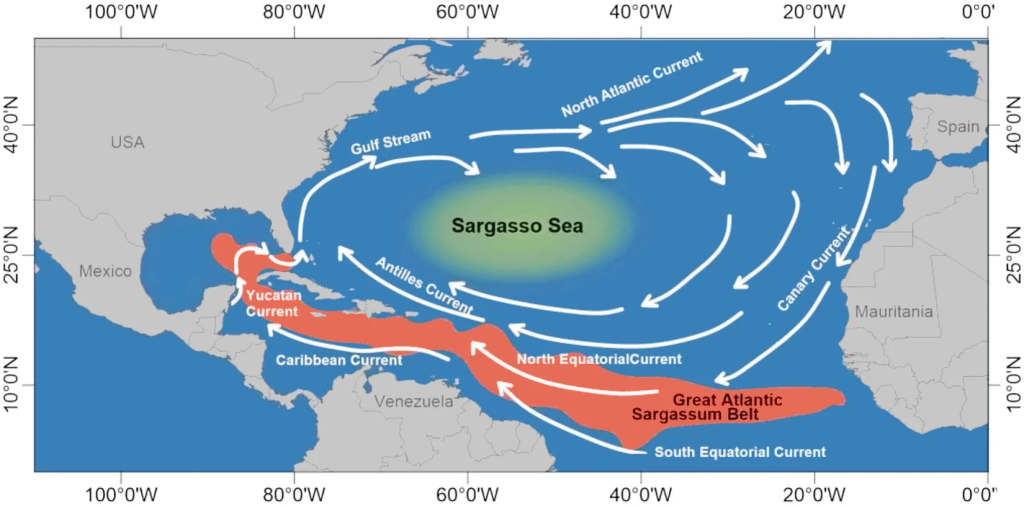
The Great Atlantic Sargassum Belt is not just large; it is gigantic. In particularly intense years, it can exceed 8,000 km in length, forming an enormous corridor of seaweed connecting the coasts of Africa to the Caribbean and the Gulf of Mexico. It is estimated to contain millions of tonnes of floating biomass, making it the largest aggregation of macroalgae on the planet. And perhaps most concerning of all, it grows larger every year and persists for longer periods, extending its presence in the ocean and increasing in volume almost continuously.
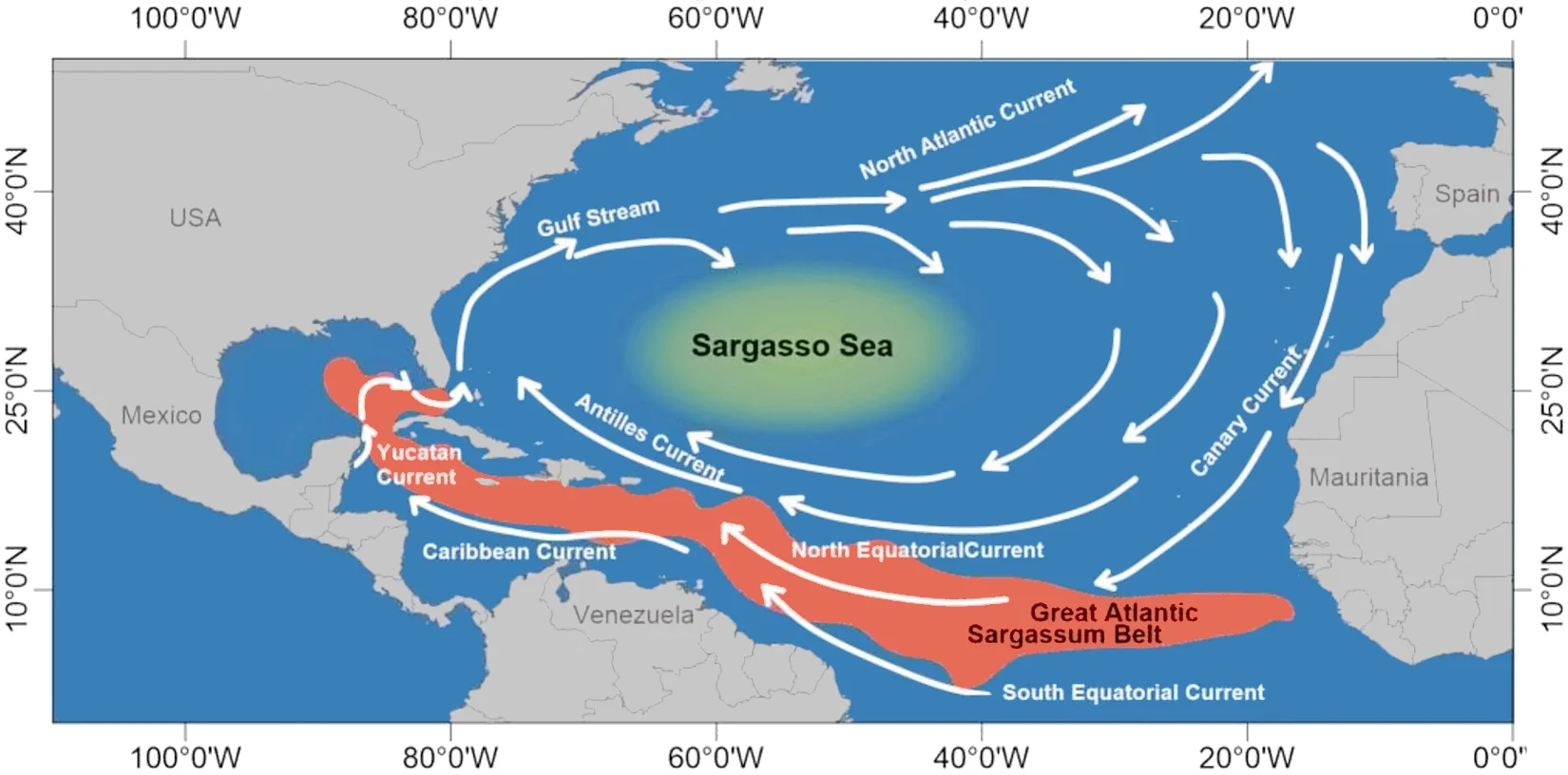
This uncontrolled growth is not random. It is closely linked to the excess nutrients entering the ocean, particularly nitrates and phosphates carried by rivers such as the Amazon. Added to this is the warming of surface waters, a direct consequence of climate change, as well as changes in ocean currents that guide sargassum like a living carpet drifting across the Atlantic. Together, these factors transform a natural and necessary element into a global-scale phenomenon.
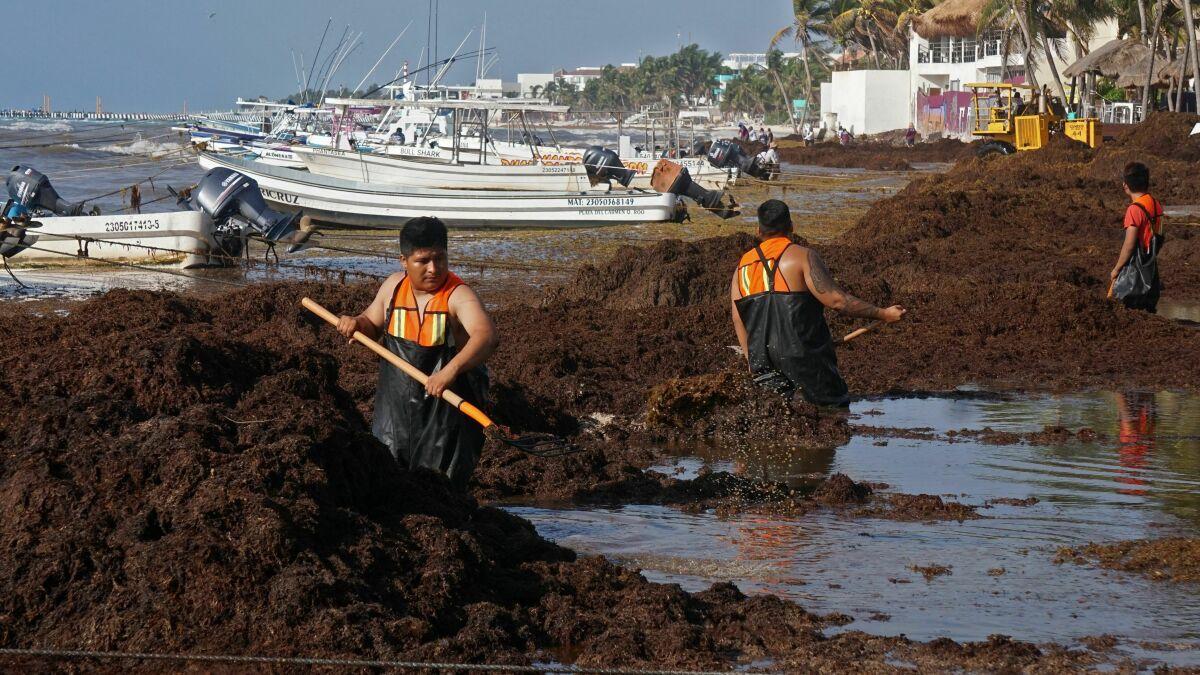
In the open ocean, sargassum remains a fascinating ecosystem. It acts as a “floating neighbourhood” where juvenile turtles find shelter, small fish seek protection, and countless planktonic organisms thrive. But when it reaches the coast, the story changes dramatically. Dense accumulations form barriers that suffocate corals and seagrass beds, preventing sunlight from reaching coastal habitats. As it decomposes, sargassum consumes oxygen in the water, creating hypoxic zones where marine life struggles to survive. To make matters worse, decomposition releases toxic gases, including hydrogen sulphide, which is responsible for strong odours and respiratory irritation.
The economic impact is also enormous. When sargassum invades beaches, it directly affects tourism, alters fishing patterns, hinders navigation, and interferes with coastal wildlife. In some tropical regions, it has become a genuine environmental and social crisis, requiring constant clean-up operations and adaptation strategies.
And what about the Azores?
Although the archipelago lies outside the main route of this belt, it is impossible to ignore the fact that the ocean is undergoing profound changes. Changes in winds and currents can occasionally push masses of sargassum further north, allowing small quantities to reach the islands. These events, still rare compared with those in tropical regions, serve as a reminder that the Azores are connected to the Atlantic in all its dimensions, from the whales that travel through it to the seaweed that journeys thousands of kilometres without ever touching the seabed.
For this reason, researchers and institutions closely monitor this floating giant using satellites and ocean models. Understanding its origins, predicting its movements, and minimising its impacts have become global scientific priorities.
The Great Atlantic Sargassum Belt is more than a natural phenomenon; it is a warning. It shows how the ocean responds to the changes we impose upon it, whether through increased nutrient inputs, global warming, or alterations in its circulation patterns. And here in the Azores, where the sea is part of the soul of the islands, monitoring these changes is essential to protecting ecosystems and continuing to celebrate the marine life that fills our waters with magic.