
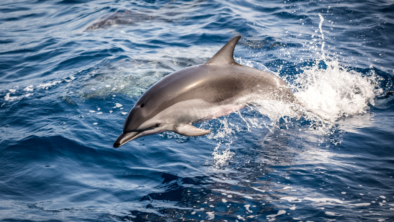
The breach of a large whale is almost certainly the most powerful action performed by any animal, and a leaping dolphin rising many meters above the surface is one of the most impressive. However, most breaching and leaping are not immediately functional activities for an aquatic animal, and a question of “Why do they do it?” is still only partially answered.
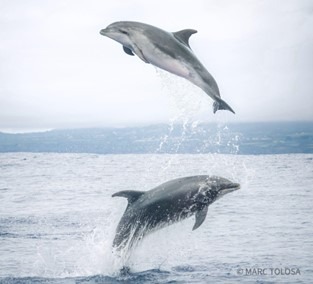
Two bottlenose dolphins (Tursiops truncatus) jumping together. By Marc Tolosa.
At the present time, the known purposes for which cetaceans jump are: playing, feeding, communicating, traveling more efficiently, interacting socially and submerging deeper.
Playing
Playing is an important component of life for cetaceans, it is prevalent among the different genres, and exhibited by individuals of all ages. When it comes to calves, which in some species begin to jump at 30 days of life, playing may help animals to acquire knowledge of objects or other aspects of their environment. Play also fosters problem-solving abilities in a safe and non-threatening environment, allowing individuals to explore new behaviors and their consequences. In the case of adults, playful aerial behavior has been observed after feeding periods.
Feeding
Observations have shown that some dolphin species, which inhabit relatively shallow waters, averaging a depth of 40m in foraging areas, perform jumps to herd schools of prey near the surface for easier capture. It has also been observed that some species of dolphins that hunt on the surface jump to capture their prey.
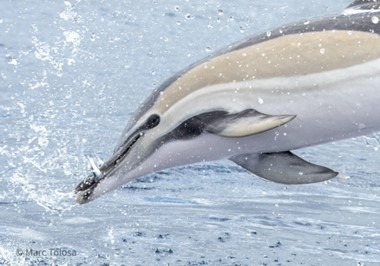
Common dolphin (Delphinus delphis) that has captured a needlefish by a jump. By Marc Tolosa.
Communicating
Dolphins’ vocalizations can be detected over many kilometers, so in order to avoid unwanted signaling to prey, predators or conspecifics, some species of dolphins also use jumps to communicate with their pod to start traveling, or to attract them to the feeding site to assist in cooperative feeding.
Traveling more efficiently
Dolphins also jump to travel more efficiently, due to the difference in density between air and water. With air being approximately 800 times less dense than water, jumping becomes a more efficient mode of travel at higher speeds compared to swimming.

Striped dolphins (Stenella coeruleoalba) jumping to travel more efficiently. By Marc Tolosa.
Social interactions
Dolphins also use jumps for social interaction. These interactions can be to socialize with other individuals, to reaffirm social bounds before a hunt, or to conduct physical encounters.
Submerging deeper
Another reason why dolphins jump is to increase the steepness of dives.
The fastest recorded jumping speeds have been exhibited by common bottlenose dolphin (Tursiops truncatus), peaking at nearly 11 m/s. Spinner dolphins (Stenella longirostris) and Humpback whales (Megaptera novaeangliae) follow closely, achieving speeds of 10 m/s and 9.1 m/s, respectively. Moreover, the incredible athleticism displayed by cetaceans during their fastest breaches may exemplify their peak capabilities.
References / Referências
Lewis G. Halsey, & Gil Iosilevskii. (2020). The energetics of ‘airtime’: estimating swim power from breaching behaviour in fishes and cetaceans. Journal of Experimental Biology, 223. doi:10.1242/jeb.216036
Paulos R. D., Trone M., & Kuczaj S. A. (2010). Play in Wild and Captive Cetaceans. International Journal of Comparative Psychology, 23(4), 701-722. doi:10.46867/ijcp.2010.23.04.06
David Lusseau. (2006). Why do dolphins jump? Interpreting the behavioural repertoire of bottlenose dolphins (Tursiops sp.) in Doubtful Sound, New Zealand. Behavioural Processes, 73, 257–265.
Würsig B., & Whitehead H. (2008). Aerial Behavior. Encyclopedia of Marine Mammals, 5-11. 2nd Edition. Perrin W. F., Würsig B., & Thewissen J.G.M.